

Full Collective Agreement
This Collective agreement is in effect as of April 22, 2026 and remains in effect until the next round of bargaining is complete.

1.1 Bargaining Agents
The Employer recognizes RDoS as the sole and exclusive bargaining agent and representative of all Residents as defined in Article 1.5, training and working in Saskatchewan health care facilities, in matters relative to the non-academic terms and conditions of training and employment and, as well, for the purpose of negotiating and bargaining collectively and concluding collective agreements which set out those terms and conditions.
RDoS, party of the first part, recognizes the Employer, party of the second part, as the sole and exclusive bargaining agent of the Employer.
1.2 Funding Agents
RDoS and the Employer recognize that the Provincial Ministry of Health is the primary source of financing medical resident training positions at the University of Saskatchewan, College of Medicine. RDoS and the Employer recognize and agree that there may be medical resident training positions approved in the College of Medicine that are financially sponsored by external agencies other than the Provincial Government. Applicants for these positions are required to be accepted for training as postgraduate medical students in the College of Medicine in accordance with the prevailing rules, regulations, policies and procedures of the College and the Employer. Persons appointed to these positions will be subject to this Collective Agreement with the exceptions noted below.
Two types of positions are recognized:
Funded Residents - Those positions for which a funding agency provides funds that provide for regular salary and benefits in accordance with this Collective Agreement; and,
Sponsored Residents - Those positions whereby the salary and benefits provided to the Residents differ from this Collective Agreement, and are coordinated directly by the sponsoring agency.
It is recognized and agreed that all of the provisions of this Collective Agreement apply to Funded Resident positions but that only non-monetary provisions of this Collective Agreement apply to Sponsored Resident positions. The articles which do not apply to Sponsored Residents are listed in Appendix A.
RDoS and the Employer acknowledge and agree that Saskatchewan health care facilities are owned and operated by the Saskatchewan Health Authority and that those corporations have exclusive jurisdiction over facilities. Consequently, RDoS and the Employer agree that this Collective Agreement cannot bind the Saskatchewan Health Authority. It is further agreed that the Employer will engage in meaningful consultation with RDoS, pursuant to Article 6.1 of this Collective Agreement, to determine points of issue and/or disagreement with the Saskatchewan Health Authority and their policies with respect to Residents, and will make every reasonable effort to resolve issues and/or disagreements in a manner consistent with the terms of this Collective Agreement and the educational objectives of the College of Medicine. For greater clarity, the terms of employment, which are reasonably expected to be provided by the Saskatchewan Health Authority to Residents, are set out at Appendix ‘B’ of this agreement.
Residents agree to abide by all bylaws, rules and regulations, which are not inconsistent with this Collective Agreement, at any health care facility in which they may receive their training or employment.
1.3 No Other Agreements
No Resident(s) shall enter into or make a separate verbal or written agreement with the Saskatchewan Health Authority or successor Corporation, The College of Medicine, University of Saskatchewan or other training/employing organizations which may conflict with the terms of this Collective Agreement. Any change in any contract term of this Collective Agreement will not be effective unless it is made in writing and signed by the parties to this Agreement.
1.4 Union Security
1.4.1 Union Dues
All Residents must pay dues as a condition of employment whether or not they accept membership in the Union. The Employer agrees to deduct monthly and remit to the Union a proportionate amount of dues within twenty-eight (28) days of such deductions, together with a list of the Residents from whom the deductions were made each month.
1.4.2 Notification of Dues Rate
It will be the Union’s responsibility to advise the Employer of the amount to be deducted and to provide at least thirty (30) days’ notice of any change therein.
1.4.3 Resident Contact Information
The Employer will collect personal contact information from each Resident upon registration and forward it to the Union office forthwith.
1.4.4 Sponsoring Agency Resident Dues
Where applicable, the Employer shall be responsible for collecting or remitting any dues for persons in a Residency program whose salary is paid directly by a sponsoring agency.
1.5 Definition of a Resident
Generally, a Resident is any postgraduate physician trainee who:
- has received an MD degree;
- is on the Educational Register of the College of Physicians and Surgeons of Saskatchewan;
- is registered as a student in the College of Medicine, University of Saskatchewan;
- is engaged in a training/employment program in any specialty of the Royal College of Physicians and Surgeons of Canada leading to Specialist certification or is engaged in a training/employment program of the College of Family Physicians of Canada leading to a Family Medicine certification; and
- is an employee of the University of Saskatchewan or who is externally funded to take residency training at the University of Saskatchewan.
2.1 Term of Agreement
This Agreement, unless modified by mutual consent, shall be in force and effect from and after January 1, 2023, up to and including December 31, 2025, and from year to year thereafter unless notice to negotiate revisions thereto is provided in writing. Any revisions in this Agreement shall be provided effective the date of signing unless otherwise stated.
2.2 Notice to Bargain
Either party may, not less than thirty (30) days and no more than ninety (90) days before the expiry date hereof, give notice in writing to the other party to negotiate revisions to this Agreement. Unless otherwise mutually agreed, negotiations shall commence within sixty (60) days of the receipt of the notice.
2.3 No Prejudice in Negotiations Involvement
No Resident involved in negotiations shall suffer any prejudice as a consequence of such involvement or activity in said negotiations. A claim that any such prejudice has occurred will be dealt with at Phase Two of the grievance procedure.
3.1 Non-Academic Matters
Non-academic terms and conditions of training/employment shall be the subject of negotiations between representatives of RDoS and the Employer subject to the provisions of Article 1.1.
3.2 Academic Matters
It is understood that hours of training/employment and exposure time with respect to in-house calls and home calls are to be considered academic in nature. Academic matters governed by, but not limited to, the Royal College of Physicians and Surgeons of Canada and the College of Family Physicians of Canada are not subject to negotiations under this contract. Notwithstanding the above, the parties have agreed to negotiate the provisions of Article 9.
3.3 Determination of Academic or Employment Matter
It is understood and agreed between the parties that the College of Medicine determines, from time to time, its policies and procedures regarding assessment of postgraduate Trainees, that these policies and procedures are subject to amendment by the College of Medicine and that the content of such policies and procedures are not, nor will be, subject to negotiation nor to inclusion within this Collective Agreement by reference or inference as the case may be.
The parties do, however, agree that in the event a dispute arises as to whether a matter is academic (non-negotiable) or employment (negotiable) in nature, and provided that the entire College of Medicine process has been exhausted, the final determination of whether or not its status is academic or employment may be referred to the Provost of the University of Saskatchewan. The Provost will follow their own procedure in deciding the matter and will, at a minimum, provide the Employer and the Union an opportunity to be heard on the matter. In the event that an alternate deliberative body is developed to assume this function, the parties will engage in meaningful consultation to agree upon an effective date for that body to replace the Provost as the decider of such disputes as to status of matters.
3.4 Electronic Copies of Collective Agreement
The parties agree that this Collective Agreement will be posted electronically on the Employer’s web site, where it may be accessed by all interested parties. Electronic copies will also be provided to all stakeholders.
3.5 Letter of Appointment
Letter of Appointment: the College of Medicine, University of Saskatchewan will send to each Resident a Letter of Appointment. The Letter of Appointment may be amended from time to time with the mutual agreement of the parties to the Collective Agreement.
3.6 CPSS Registration Form
A College of Physicians and Surgeons of Saskatchewan Registration Form will be forwarded to the incoming or continuing Resident. This form must be processed prior to the commencement of training/employment.
3.7 Discrimination and Harassment
Residents are covered under the Employer’s Discrimination and Harassment Prevention Policy and Procedures. It is agreed that a Resident must exhaust that Policy before resorting to external avenues as may exist.
4.1 Interest Arbitration
In the event that the parties have bargained collectively for the renewal of this Agreement and cannot conclude such renewal, either party may refer all outstanding issues to an interest arbitrator whose determination of the same shall be final and binding upon the parties. Notwithstanding such reference, nothing shall preclude the parties from additional discussions up to and including the conclusion of a new Collective Agreement.
4.1.1
Once a party has invoked the interest arbitration protocol, it is agreed and understood that the parties will forthwith request the assistance of a mediator from the Provincial Ministry of Labour Relations and Workplace Safety (or its successor) to develop the list of issues which will be referred to interest arbitration. The parties agree to make their best efforts to expedite this process. All matters tentatively agreed in negotiations will remain tentatively agreed and will form the balance of the renewed Collective Agreement at the conclusion of the arbitration process.
4.1.2
The parties will, prior to mediation, begin discussions on naming the arbitrator. Once the mediation process has concluded, if no agreement has been reached on an arbitrator, the Chairperson of the Labour Relations Board will appoint the arbitrator. The arbitrator’s jurisdiction will be limited to the matters listed by the parties via mediation. The arbitrator shall determine the procedure to be followed, but in so doing shall afford the parties a full opportunity to make their submissions on the issues submitted. The arbitrator shall render a decision as soon as reasonably practicable but in any event within one hundred and eighty (180) days of the close of the arbitration hearing.
4.1.3
The parties agree to share equally the arbitrator’s account for services rendered. The parties will pay their own expenses.
5.1 No Strike/No Lockout
The parties agree that there will be no strike or lockout at any time so long as this Collective Agreement is in force, including such periods of renegotiation as may occur from year to year.
5.1.1
There shall be no strike, slow-down, or other interruption of training/employment in any form on the part of RDoS or any Resident represented by RDoS during the term of this Collective Agreement.
5.1.2
There shall be no lockout by the Employer during the term of this Collective Agreement.
5.2 Essential Services
The parties agree that in recognition of the important role played in the delivery of medical services by RDoS members, Article 5 represents the Essential Services Agreement required under the provisions of The Public Service Essential Services Act.
6.1. Phase One: Emergent Issues Discussion
Where a concern arises relating to actions, policies or directions of the SHA, and time is of the essence, collegial discussions should be undertaken as soon as possible between the designated representatives of the Union and the College of Medicine’s officials in the following order:
1. Program Director
2. Associate Dean, Postgraduate Medical Education
3. Dean of Medicine (or designate)
In this Phase, the intention of the parties is to identify issues and seek the assistance of the College of Medicine (CoM) in clarifying/correcting/resolving the issue(s). It is understood that the CoM will engage the SHA in an effort to achieve a timely result and that such result will be reported back to the Union as soon as practicable.
Matters referred to Phase One are not subject to the grievance procedure provided in this Agreement.
6.2. Phase Two: JCC – Evolving Issues Within University Jurisdiction
A Joint Consultative Committee (JCC) shall be established with a maximum of four (4) members appointed by each of the Employer and the Union. The JCC shall meet at the request of either party. There will be no requirement as to quorum so long as each party to this Agreement is represented. There will be no voting, and each party is responsible for its own notes. Where possible, agenda items should be shared in advance of the actual meeting. The goals and objectives of the JCC shall include:
- establishment of a forum for the collegial exchange of information and ideas
- the review of matters of mutual concern
- discussion as to whether an issue is or is not academic in nature
- other matters of concern raised by either party
While the JCC shall not be a forum for the discussion of grievances, per se, matters originally raised in Phase Two may be elevated to the grievance procedure in Phase Three by either party provided that this is done in writing within thirty (30) days of the date of the JCC discussion of the same and that the matters relate to the alleged violation of one (1) or more provisions of this Agreement.
6.3. Phase Three: Grievance Procedure – Contractual Disputes
A dispute regarding the application or interpretation of this Agreement with respect to non-academic matters, or a contention that formal discipline has been applied without just cause may be referred by a Resident, through the Union, to the grievance procedure. The Union or the Employer may also commence a policy grievance regarding a matter of general application or interpretation. A Resident shall have the right to Union representation at any stage of the grievance procedure.
6.3.1 Step One: Initiation of Grievance
A written statement of grievance must be filed within thirty (30) calendar days of the date of occurrence of the matter which gives rise to the complaint or when the JCC has completed discussion of the matter as the case may be. The Union shall file such grievance with the Associate Dean, Post-Graduate Medical Education, or designate. The Employer shall file such grievance with the President or Chief Executive Officer of the Union. The party receiving a grievance shall have fourteen (14) calendar days to respond. In the event no response is forthcoming, the grievance will advance to the next step.
6.3.2 Step Two: Review
If the party that initiated the grievance considers the response of the other party unsatisfactory, the matter may be referred to Step Two, where a review meeting or meetings will occur, commencing within thirty (30) days of such reference. The meeting or meetings will involve, at a minimum, the Associate Vice-President, People and Chief Human Resources Officer of the Employer and the Chief Executive Officer of RDoS, or their designates. Every effort will be made to negotiate a settlement to the grievance.
If the grievance cannot be resolved, either party may refer the matter to arbitration within thirty (30) days of the last Step Two meeting relating to it.
6.3.3 Step Three: Arbitration
Failing resolution of a grievance at Step Two, the matter may be referred to arbitration by means of written notice from the referring party to the other party. The appropriate representatives to receive such notice shall be the Associate Vice-President, People and Chief Human Resources Officer and the Chief Executive Officer of the Union respectively. The notice shall contain at least one (1) proposed arbitrator to hear and decide the matter. The party receiving the notice shall respond with agreement to a proposed arbitrator, or, alternatively, the name of one (1) or more proposed arbitrator(s). In the event that the parties are not able to reach agreement upon an arbitrator within thirty (30) calendar days from the giving of the notice, either party may request that the Chair of the Saskatchewan Labour Relations Board appoint an arbitrator.
No person who has a pecuniary interest in the arbitration or has acted as solicitor or counsel to either party within twelve (12) months of the date of the grievance shall be eligible to act as arbitrator. The parties will equally share the expenses and fees relative to the arbitration hearing, and each will bear their own costs as to representation and witnesses.
The arbitrator shall determine the procedure to be followed but in so doing will afford the parties a reasonable opportunity to present sworn evidence as well as argument. The arbitrator shall have no jurisdiction to amend, alter, enlarge, reduce or modify this Agreement, or to render any academic judgment. The arbitrator shall hear and determine the dispute and issue whatever decision is deemed just and equitable, such decision being final and binding upon all parties involved, subject only to judicial review by the Court of King’s Bench. It is expected that the arbitrator will render a written decision within one hundred and eighty (180) days of the hearing.
All time limits in this procedure may be extended by mutual agreement of the parties, reduced to writing. Officers of the Union and, where applicable, a griever represented by the Union, shall be allowed reasonable and necessary time off without loss of pay to attend meetings relating to a grievance. This provision does not extend to arbitration hearings or proceedings before the Labour Relations Board or the Courts.
No Resident shall suffer any prejudice as a consequence of recourse to this grievance procedure. A complaint that any such prejudice has occurred shall be commenced at Step Two of this procedure.
7.1 Level of Pay
It is agreed that the level to be paid each Resident shall be the responsibility of the Associate Dean, Postgraduate Medical Education, College of Medicine, acting on the recommendation of the appropriate Program Director. The classification for remuneration of Residents shall conform with the level of their approved training as recognized by the Royal College of Physicians and Surgeons of Canada, or the College of Family Physicians of Canada
7.2 Transfers
A Resident who transfers into another program shall receive credit for previous training in terms of the number of completed years of approved training according to the requirements and regulations of the program to which they are transferring as defined by the Royal College of Physicians and Surgeons of Canada, or the College of Family Physicians of Canada.
7.3 PGY Definitions
Subject to the considerations established in Article 7.1 and 7.2, remuneration levels for Residents will be defined as follows:
7.3.1
Postgraduate Year 1 refers to medical graduates in the first year of a program as determined by the College of Family Physicians of Canada or the Royal College of Physicians and Surgeons of Canada.
7.3.2
Postgraduate Year 2 refers to all residents in the second year of a program as determined by the College of Family Physicians of Canada or the Royal College of Physicians and Surgeons of Canada.
7.3.3
Postgraduate Year 3 refers to all residents in the third year of a program as determined by the College of Family Physicians of Canada or the Royal College of Physicians and Surgeons of Canada.
7.3.4
Postgraduate Year 4 refers to all residents in the fourth year of a program as determined by the College of Family Physicians of Canada or the Royal College of Physicians and Surgeons of Canada.
7.3.5
Postgraduate Year 5 refers to all residents in the fifth year of a program as determined by the College of Family Physicians of Canada or the Royal College of Physicians and Surgeons of Canada.
7.3.6
Postgraduate Year 6 refers to all residents in the sixth year of a program as determined by the College of Family Physicians of Canada or the Royal College of Physicians and Surgeons of Canada.
7.3.7
Postgraduate Year 7 refers to all residents in the seventh year of a program as determined by the College of Family Physicians of Canada or the Royal College of Physicians and Surgeons of Canada.
7.3.8
Postgraduate Year 8 refers to all residents in the eighth year of a program as determined by the College of Family Physicians of Canada or the Royal College of Physicians and Surgeons of Canada.
7.4 Reclassification
Residents may not be reclassified to a lower pay level during an appointment without just cause.
7.5 Advancement
Residents shall advance at least one (1) pay level for each successfully completed postgraduate training year, subject to the provisions of Articles 7.1 and 7.2.
8.1 Annual Salaries
- Effective January 1, 2023: increase all levels by 4.5% retroactive to any Resident in Program at the time; and
- Effective January 1, 2024 : increase all levels by 3.5% retroactive to any Resident in Program at the time; and
- Effective January 1, 2025 : increase all levels by 2.5% retroactive to any Resident in Program at the time
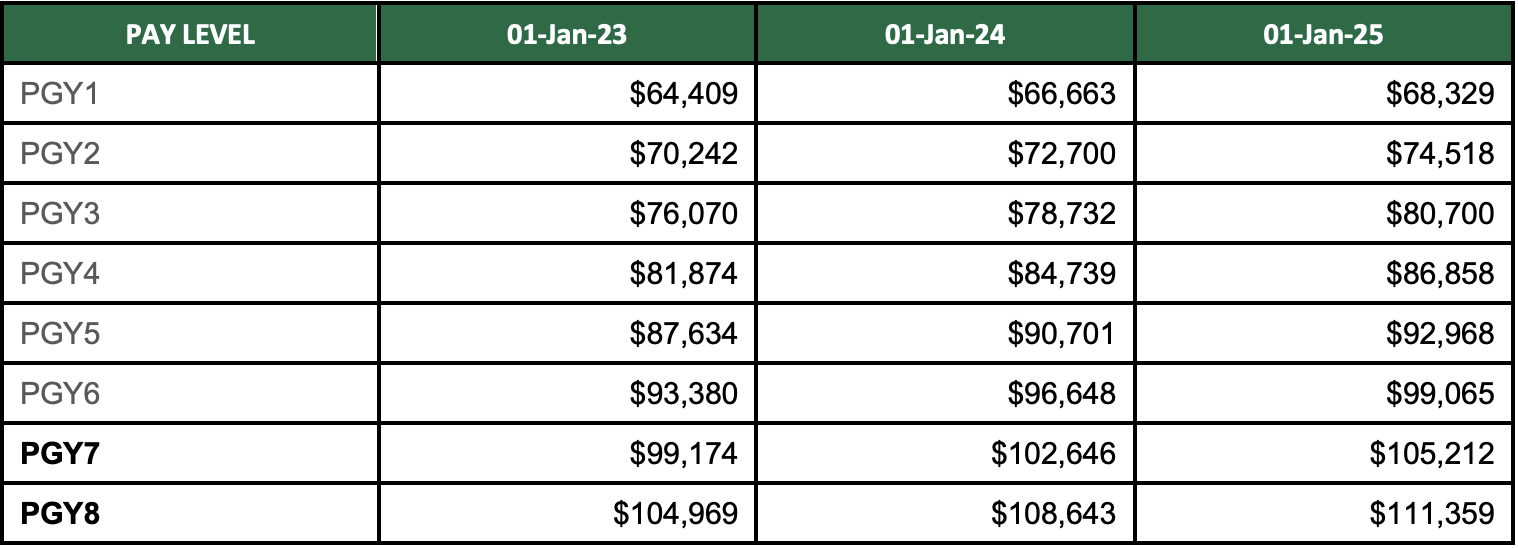
8.2 Clinician Investigator Program Salary Progression and Stipend
Residents enrolling in the Clinician Investigator Program (CIP) at the successful completion of a postgraduate year are entitled to receive the normal PGY salary advancement for completing the previous PGY level. Residents enrolled in the CIP will then remain at the same PGY level for the duration of their enrolment in the CIP. Upon completion of the Clinician Investigator Program, the resident will return to their home program, at the same PGY level they held during the CIP, to complete training, progressing normally on the salary scale.
Residents enrolling in the CIP in the middle of a postgraduate year will enter the CIP at their current PGY salary level. Their next salary increase will align with completion of a PGY level in their home program.
Residents enrolled in the Clinical Investigator Program will receive an annual stipend of $5,000 in the first month of each academic year they are enrolled in the CIP. This stipend is in addition to any salary, call stipends and administrative stipends to which they are already entitled.
8.3 Administrative Resident Stipends
A Resident designated as Administrative Resident by the appropriate Program Director shall earn stipends and enjoy paid Administrative time for duties as defined in the Resident Handbook based on the following provisions:
- Fifteen (15) or fewer Residents in Program = minimum 0.5 day per month
- Sixteen (16) or fewer Residents in Program = minimum 1.0 day per month
- Effective January 1, 2023 $183.72 annually per Resident in Program
- Effective January 1, 2024 $190.15 annually per Resident in Program
- Effective January 1, 2025 $194.91 annually per Resident in Program
Where a Resident is designated for a partial year or where two (2) or more Residents share the designation, the annual stipend and allotted time shall be prorated.
Stipends will be paid at the end of December based on the Program census as of October 15 that year, and at the end of June based on the Program census as of April 15 that year.
8.4 Employment Insurance Rebate
So long as there continues to be an Employment Insurance Rebate program in force, and so long as the Employer continues to qualify for same, the Employer agrees to pay the per employee share of such rebate to the Union as, and if, required by the Rebate program.
9.1 Call Stipends
Home Heavy call is defined as:
- A home call where during the period of 5:00 pm and 8:00 am, the resident has to spend more than four (4) hours after 5:00 pm and/or two (2) hours after midnight out of home (i.e., in the hospital) more than fifty percent (50%) of the time and over a given call period.
- A home call during a weekday or stat holiday, where the resident has to spend twelve (12) hours or more during a twenty-four (24) hour period in the hospital more than fifty percent (50%) of the time over a given call period.
Please note that every hour in the hospital after midnight will count as two (2) hours for the calculation. This formula is used to determine the call designation for each specific program and each specific call period. Any Home call not meeting the above definition is Home Light.
Home Heavy:
- Effective January 1, 2023 per duty period: $116 weekday, $134 weekend
- Effective January 1, 2024 per duty period: $120 weekday, $138 weekend
- Effective January 1, 2025 per duty period: $123 weekday, $142 weekend
Home Light:
- Effective January 1, 2023 per duty period: $76 weekday, $88 weekend
- Effective January 1, 2024 per duty period: $79 weekday, $91 weekend
- Effective January 1, 2025 per duty period: $81 weekday, $93 weekend
In House:
- Effective January 1, 2023 per duty period: $177 weekday, $203 weekend
- Effective January 1, 2024 per duty period: $183 weekday, $210 weekend
- Effective January 1, 2025 per duty period: $187 weekday, $215 weekend
Call Conversion:
A Resident who is scheduled for Home Call but who works more than four (4) hours in clinical duties during the call period, of which more than one (1) hour is past midnight and before 0600 hours, shall be remunerated at the In-House call rate for that call duty period.
The Employer shall have the right to implement reasonable rules to verify that the Resident qualifies for call conversion for that call duty period.
9.2 In-House Call Duty
Both parties hereto accept that, in order to provide adequate service and care to patients and to enhance the medical education of Residents and so facilitate the realization of their educational objectives, that duty hours be limited to provide a balance of patient care, clinical experience and academics. No Resident will be required to do more than one (1) in four (4) in-house call averaged over an academic rotation. The duty period referred to is from 1700 - 0800 hours Monday through Friday, and 0800 - 0800 hours Saturday, Sunday and statutory holidays. This duty period shall be referred to as “in-house-on-call” duty.
In services where in-house call is scheduled as partial or split-shifts (scheduled as less than 1700-0800 weekdays or 0800-0800 weekends), each part of the partial call shift or split-shift constitutes one call duty period for the purposes of call frequency maximums and call stipends.
Exceptions, based on academic need or exceptional situations, will be monitored by RDoS and the College of Medicine. Where concerns arise, discussion will be held at a Joint Consultative Committee meeting.
9.3 In-House Excess Call
In the event that a Resident voluntarily performs In-House call duty in excess of one (1) in four (4) by assignment, such work will be paid at the following rates:

There will be no prorating of these amounts for partial duty periods. Extension of hours pertaining to a critical medical situation or completion of training or service requirements will also not be considered. Extra rotations in excess of the principle of one (1) in four (4) averaged over an academic rotation will be voluntary and must have the mutual consent of the Resident and the Program Director.
With the agreement of the Program Director or the Administrative Resident where this duty has been delegated by the Program Director, the existing practice whereby residents may interchange duty hours amongst themselves is recognized, provided that adequate patient care is provided. Permission for such interchange will not be unreasonably withheld, but consecutive twenty-four (24) hour shifts will never be considered. The reason for the rotation in excess of the principle of one (1) in four (4) averaged over an academic rotation must be clearly defined so as to be able to determine that the Resident doing the excess rotation is to be remunerated.
9.4 Home Call Duty
No Resident will be required to provide more than one (1) in three (3) call averaged over an academic rotation.
9.5 Blended Call Frequency Maximums
For the purpose of determining the maximum number of call shifts when a resident is on both in-house and home-call within the same rotation, the “blended call frequency formula” will apply:
The total number of home-call assignments multiplied by three (3) plus the total number of in-house call assignments multiplied by four (4) shall not exceed a total of thirty (30) over a twenty-eight (28) day period.
(# of Home Call Shifts x 3) + (# of In-House Call Shifts x4) < 30 in 28 day period
9.6 Training Hours
A Resident will be scheduled to work a reasonable number of hours. The training/ employing organizations will undertake to limit the average number of hours, having due regard for sound patient care and treatment, and the educational requirements of the Resident’s program.
9.7 Invitations When Not On Call
Residents who are not on call may be contacted and invited to participate in a case. However, except in the event of an emergency of qualified medical personnel not being available, all residents will be free to decline such invitations.
Residents who are not scheduled to be on call will not be expected to attend rounds on Saturdays and Sundays that are for service purposes only. However, this does not preclude the scheduling of teaching sessions on weekends, which Residents will be expected to attend.
9.8 Limitations on Work Periods
9.8.1 Home Call Handover
Residents are to be relieved of clinical responsibilities after twenty-six (26) hours from the previous day’s start time on the first post-call day at the Resident’s professional discretion at such point as they feel their ability to safely care for patients may be compromised.
9.8.2 In-House Call Handover
A Resident who is required to provide care of a continuing or intensive nature shall be relieved after patient care handover. Patient care handover shall commence at the 24th hour and not exceed two (2) hours. No new clinical duties shall be assigned or undertaken after twenty-four (24) hours barring emergent circumstances. The Resident shall resume work on regularly scheduled hours the subsequent work day.
9.8.3 Call Schedule Posting
Final call schedules for each service shall be provided to residents and RDoS no less than four weeks in advance of the first day of the block. With the agreement of the Program Director or the Administrative Resident where this call has been delegated by the Program Director, the existing practice whereby Residents may interchange call hours amongst themselves is recognized, provided that adequate patient care is provided. Permission for such interchange will not be unreasonably withheld.
9.8.4 Emailing Call Schedules to RDoS and PGME
Program Directors, via the Program Administrator with the assistance of the Administrative Resident as necessary, will email to RDoS all final resident duty schedules on the day they are posted in the program.
9.9 Reallocation of Call Duties and Call for More than One Service
In the event that a particular service or elective period does not have on-call duty periods, the Resident shall not be reallocated to do on-call duty periods on another duty service unless a traditional combination of more than one (1) service on-call block applies. The foregoing shall not mean that the Postgraduate Program shall be precluded from the implementation of new call arrangements in the furtherance of educational objectives to meet changing needs or new programs.
Persons on a service with on-call duties will not be available for on-call duties on another service (be the call in-house or out-of-house on either service).
9.10 Alternate Call Scheduling Models
Call scheduling models which differ from the limits outlined in this collective agreement may not be implemented until they have been reviewed and approved by both PGME and RDoS. PGME will maintain a repository of all existing alternate call scheduling models. Changes to existing alternate call schedule models will require new review and approval before implementing the changes.
9.11 Back-Up Call Schedules
Before implementing back-up call schedules, programs must obtain approval from both PGME and RDoS. Residents on back-up call schedules will be paid home-light stipends, regardless of whether they are called in to work the shift. Call conversion will apply to any shift worked where the call duties became in-house in nature during the shift, and in-house stipends will be paid in these instances. PGME will maintain a repository of all existing back-up call schedules. Changes to existing back-up call schedules will require new review and approval before implementing the changes.
9.12 Prorating Number of Call Shifts
Vacation time, sick leave and leave of absence for any purpose shall not be regarded as time available for on-call duty periods; rather, the number of duty periods shall be pro-rated to the number of days actually worked.
9.13 Consecutive Weekends
Other than in exceptional circumstances, no Resident shall be selected to be on call for more than two (2) out of three (3) consecutive weekends. Once in every three (3) week cycle, a Resident must have from the end of the regular working day on Friday until the start of the working day on Monday morning free from clinical responsibilities.
The onus is on the Resident to notify the upcoming rotation coordinator at least five (5) weeks in advance in order to accommodate scheduling, so that the Resident will not be required to work more than two (2) out of three (3) consecutive weekends when changing rotations. If the Resident does not have their upcoming schedule at least four (4) weeks in advance, the Resident should immediately notify the relevant schedulers who will then be responsible for aligning the two (2) call schedules so that they do not violate the two (2) out of three (3) rule.
9.14 Consecutive 24-Hour Call
In the interest of patient safety and Resident well-being, neither party encourages consecutive twenty-four (24) hour call. However, it is recognized that residents may on occasion choose to do consecutive twenty-four (24) hour call on certain services. With the approval of the appropriate program committee(s), Residents assigned to those services may opt to accept sequential twenty-four (24) hour call periods. This option must be exercised prior to preparation of call schedules.
9.15 Shiftwork
For those Residents who participate in shiftwork, including but not limited to Emergency Medicine, Internal Medicine, Obstetrics and Gynecology, and Pediatrics; shifts shall not be scheduled in excess of five (5) shifts per week, with maximum duty hours pro-rated by duration of shift. For example, CTU float shifts at twelve (12) hours per shift, and ER shifts at eight (8) hours per shift. No resident shall be expected to participate in clinical duties for twelve (12) hours preceding and after the shift.
For Residents with extra clinical duties, for example Family Medicine Residents with obstetrical duties, any excess clinical duties shall be restricted per call frequency and duration expectations. This includes maximum number of days spent performing excess duties per month, as per current call and shiftwork restrictions. If the Resident’s duties meet the requirements for call conversion, the resident shall be appropriately compensated and be entitled to a post-call day.
9.16 Transportation Home after Late Night Work
To ensure Resident and Public safety, Residents who feel they are unsafe to drive their vehicle from the training facility to their place of residence after working anytime between 12:30 am - 9:00 am will be fully reimbursed by the Employer for taxi/rideshare fare home. Supporting receipts will be required for any such claim and may be rejected by the Program Director if found unreasonable.
10.0 – Provision of Phlebotomy / Electrocardiology Services
The provision of phlebotomy and electrocardiology services will only be done to fulfill educational objectives as determined by the Residency Program Director in consultation with the Residency Program Committee.
11.1 Statutory Holidays Include
- New Year’s Day
- Family Day
- Good Friday
- Easter Monday
- Victoria Day
- Canada Day
- Saskatchewan Day
- Labour Day
- National Day for Truth and Reconciliation
- Thanksgiving Day
- Remembrance Day
- Christmas Day
- Boxing Day
11.2 Statutory Holiday Pay
Residents who are scheduled and work on a statutory holiday or any portion thereof shall be entitled to either:
1 regular day’s salary + 0.5 day’s salary + 1 day in lieu to be used at a later date
OR 1 regular day’s salary + 1.5 day’s salary
If requesting the first option, the day in lieu must:be submitted to the College of Medicine within a thirty (30) day period before or after the day of the statutory holiday be shown explicitly on the duty schedule within the academic year wherever possible, or up to sixty (60) days into the new academic year for returning residents.
Subject to the mutual agreement between the Resident and Program Director, this benefit will be prorated on the basis of an eight (8) hour day if a resident is on call for less than eight (8) hours on a statutory holiday.
Payment for statutory holidays must be issued before the end of the academic year in which it was accrued.
11.3 Stat in Lieu Benefit
When a statutory holiday falls on a weekend, the University will declare either the Friday before or the Monday following the weekend as the “stat in lieu” day.
If a resident works on a stat in lieu day, they will receive one paid day off to be used within the academic year. No additional pay will be issued.
11.4 Calculation of One Day’s Pay
For the purpose of pay calculation, one (1) day’s pay is calculated as follows:
Normal daily rate of pay = current annual rate ÷ by 261 normal duty days
Current annual rate is defined in Article 8.1.
11.5 Premium Pay for Statutory Holiday
Premium pay for being on duty the day of a statutory holiday shall be paid for the actual calendar day, and shall not be paid for any alternate named day.
11.6 Statutory Holiday on Day Off
If a statutory holiday falls on a Resident’s regularly scheduled day off or during the vacation period, such Resident shall receive an additional day off with pay. Such day off shall be shown explicitly on the duty schedule.
11.7 Seasonal Slowdown
Subject to patient care requirements as determined by the College of Medicine, Residents will receive six (6) consecutive calendar days off duty with pay in lieu of the Christmas and New Year’s Day statutory holidays. Any additional time off contiguous with the six (6) days shall be at the discretion of the College of Medicine.
Residents who are post call on their first of six (6) consecutive calendar days off will receive an additional day in lieu to be scheduled any time in the corresponding academic year, provided they were receiving only six (6) consecutive days off.
It is agreed and understood that this provision takes advantage of the traditional seasonal slowdown in health services to afford Residents with a period of rest and reflection away from their regular duties between December 20 and January 5.
There shall be no additional payment or time off for Residents who have worked on any statutory holiday between December 20 and January 5, provided they have received their six (6) day block as described above. The parties recognize that this provision represents a special situation and that regular work week and weekend is to be maintained in the duty schedule prior to and/or after the six (6) day block. Residents and Program Directors will mutually determine the necessary adjustments to duty schedules to implement this clause in a manner consistent with Article 9.
The Employer will accommodate the interests of Residents in the observation of their religious/cultural holidays. A Resident may request, with the approval of the Program Director, that the six (6) consecutive days off duty during seasonal slowdown be scheduled to another time to accommodate the observance of an alternative religious/cultural holiday.
The six (6) day block cannot be separated into smaller parts, and thus can only be used once in the corresponding academic year. A Resident who is granted an alternate six (6) days off to observe an alternate religious/cultural holiday shall work normal duty hours and call as applicable during the period between December 20 and January 5. They shall not receive additional payment or time off for working any stat holidays during the seasonal slowdown, provided they have received their six (6) consecutive days off within the corresponding academic year.
11.8 On-Call Duty on the Middle Day of a Long Weekend
Where a Resident is scheduled for the middle day(s) of a long weekend, this person is entitled to a paid day(s) off. The paid day off must be arranged with the Program Director (or the Administrative Resident where this authority is delegated by the Program Director) and taken before the end of the academic year in which it was accrued, or up to 60 days into the new academic year for returning residents.
The on-call period on the middle day is defined as 0800 to 0800. Any Resident who works a minimum of eight (8) hours (in-house or out-of-house) on the middle day is entitled to a day off. When the middle day overlaps the statutory holiday from 2400 hours to 0800 hours, the Resident is entitled to claim the greater of the two (2) benefits. The Resident shall be entitled to claim only one (1) benefit in a twenty-four (24) hour period.
12.0 – Moving Provisions
Immediately prior to the commencement of a training program, elective, or fellowship which requires a move from one location to another, Residents must be free from clinical duties (no call, no shiftwork) from the end of the regular working day Friday (but no later than 2000 hrs) through Monday before their regular working day begins. Additional time may be granted at the Program Director’s discretion.
13.1 Vacation Leave
13.1.1
Each Resident shall receive, during each year of Residency training, four (4) calendar weeks of paid annual vacation. This is equivalent to twenty (20) regular working days. Vacation leave is not required for activities which are considered normal aspects of a residency program such as teaching and college mandated education.
13.1.2
Vacation leave will be arranged such that any instance in which five (5) or more regular working days are taken consecutively, Residents will not be placed on duty the weekend directly before or after, and also, any weekend(s) which falls within the vacation period. Clinical duties will end at the end of the regular working day on Friday, no later than Friday midnight.
13.1.3
No individual rotation-specific vacation policy shall apply. In the case where rotations refuse a requested vacation period, the reason for refusal shall be shared with the resident and parent Program Director. If the reason is not deemed satisfactory by the parent Program Director, the Resident’s request shall be upheld. Any routine policy for refusal of vacation requests is deemed a violation of the collective bargaining agreement.
13.1.4
A Resident with an appointment period of less than one (1) year shall earn and receive vacation time at the rate of one and two-third (1 2/3) days per calendar month or major portion thereof.
13.1.5
A Resident shall receive regular pay in lieu of any vacation leave remaining at the end of an academic year if, for any reason, it was not possible to take the vacation leave within the academic year. Alternatively, if a consecutive appointment is being made, unused vacation leave to a maximum of two (2) weeks may be carried over to the following year with the approval of the Program Director.
13.1.6
Where practicable, vacation leave must be approved at least two (2) weeks ahead of the commencement date. Program Directors will not unreasonably deny vacation requests.
13.1.7
If a Resident becomes seriously ill, seriously injured, or hospitalized during a period of vacation leave, the Resident may apply to the Employer through the Office of Postgraduate Education to have the period of vacation leave replaced by sick leave. The Resident shall provide documentation to support the claim. If the request is approved, the period of vacation so displaced shall be reinstated for use as vacation and scheduled in the normal manner.
13.2 Sick Leave
13.2.1
Residents shall, upon commencement of training/employment, be credited with fifteen (15) days sick leave. In the second (2nd) and subsequent consecutive year(s) of training/employment, sick leave shall be earned and credited at the rate of one and one-quarter (1 ¼) days per month of training/employment cumulative over the length of training/employment.
13.2.2
A Resident who is appointed for a term of less than one (1) year shall receive a pro-rata Sick Leave credit upon commencement based on the one and one-quarter (1 ¼) days per month of appointment.
13.2.3
Residents may use sick leave to attend their own medical appointments, to care for their children during illness, and to take their children to medical appointments.
13.2.4
A Resident shall provide evidence of such illness or disability as reasonably required by the Program Director. Residents shall notify the Program Director or the Program Director’s office when absent due to illness.
13.3 Compassionate Leave
Compassionate leave with pay shall be granted to a maximum of three (3) days to attend to arrangements upon the death or serious illness where death is imminent of a spouse, common law partner, fiancé/fiancée, father, mother, child, brother, sister, mother or father-in-law, grandparent, legal guardian, or legal ward. An additional two (2) days with pay may be granted by the Program Director for travel purposes. Compassionate leave for instances not listed above, will be at the discretion of the Program Director. Leaves will not be unreasonably denied.
13.4 Maternity Leave, Parental Leave and Adoption Leave
13.4.1 Maternity Leave
A pregnant resident is entitled to Maternity leave. Maternity leave shall be provided pursuant to The Saskatchewan Employment Act. Written application for Maternity leave must be submitted to the Resident’s Program Director as soon as reasonably possible, but in any event not less than four (4) weeks prior to the planned start date of such leave.
If the condition of a pregnant Resident so justifies, that Resident shall, upon submission of a medical certificate signed by a medical doctor have duties amended to meet the medical requirements. On call and night shifts will cease at twenty-seven (27) weeks of gestation unless the employee provides a medical note allowing them to continue with those duties. The inability to do call shall not be used to justify a demand that the employee cease work.
13.4.2 Supplementary Employment Insurance Benefit
Residents granted Maternity Leave will receive a supplemental benefit of ninety-five percent (95%) (inclusive of Employment Insurance) of their regular salary (based on pre-leave earnings) for a period of up to twenty-one (21) weeks (including the one (1) week waiting period.)
It is agreed that in such circumstances, the Resident’s total earnings (all sources) cannot exceed 95% of pre- maternity earnings. Regular weekly earnings for purposes of administration of this clause will be determined by dividing the Resident’s annual pay rate in effect on the last day worked prior to commencement of the leave by 52.14. The Employer’s obligation for payment of this supplement shall not extend beyond the period of the contracted appointment if the Resident has completed her requirements as set out by the relevant accrediting body.
13.4.3 Continuity of Employment Benefits
Accumulated sick and vacation leave as of the date Maternity/Parental leave commences shall be retained but will only accumulate during the paid portion of the leave (21 weeks) and not accumulate during the remainder period of Maternity/Parental leave.
Group Life and Long Term Disability insurance shall be continued as was the case prior to this leave subject to any conditions set by the underwriters.
Dental, Extended Health Insurance, and optional Life and Disability Insurances, may be maintained provided the Resident pays all required premiums during the unpaid portion of this leave. The University will notify Residents of the options and costs of continuing benefits during a Maternity/Parental leave.
13.4.4 Adoption Leave
A member who declares in writing to be the adoptive parent of an adopted child is entitled to adoption leave. The length and timing of the leave shall be consistent with the provisions in The Saskatchewan Employment Act.
As per the Act, the member is required to apply for this leave at least four (4) weeks prior to the date the member begins to care for the child (“care date”). If the member cannot give four (4) weeks’ notice, the Employer will accept as much notice as is given to the adoptive parents by Saskatchewan Social Services or the adoption agency.
The leave must commence on the care date, or at any time during the thirteen (13) week period prior to the estimated care date, and shall be of uninterrupted duration.
13.4.5 Parental Leave for Maternity or Adoption
A member who qualified for maternity or adoption leave is also entitled to parental leave without pay. The length and timing of the leave shall be consistent with the provisions The Saskatchewan Employment Act. The parental leave is in conjunction with the maternity or adoption leave and must be taken in one continuous period.
13.4.6 Parental Leave for Those Not Qualifying for Maternity or Adoption Leave
Residents who do not qualify for maternity or adoptive leave, and are as such the non-birthing parent of a newly born or adopted child, are entitled to parental leave without pay as pursuant to The Saskatchewan Employment Act. As per The Act the Resident is required to apply for this leave at least four (4) weeks prior to the commencement of the leave or as soon as possible in extenuating circumstances.
The Employer will provide five (5) consecutive paid workdays of parental leave for the non-birthing parent to be taken within thirty (30) days of the date of birth or adoption.
13.5 Education Leave
Residents shall be entitled to paid leave to attend educational events (such as conference, courses and modules) at their discretion, either in-person or online, which are relevant to their academic program, recommended by their Program Director and approved by the Associate Dean of Postgraduate Medical Education. The leave available shall be a minimum of seven (7) and a maximum of twelve (12) regular weekdays per academic year inclusive of travel time and shall not accumulate from year to year. Weekends do not require the use of education leave days, as they are not regular workdays. College mandated education or training is considered part of the residency program and therefore does not require the use of education leave.
Residents approved for Education Leave shall be expected to provide a report on their educational activity to their colleagues and Program Director.
13.6 Examination Leave
A Resident shall receive paid leave to sit the following examinations:
- Medical Council of Canada Exams
- Surgical Foundations Exam
- College of Family Physicians of Canada certification
- Royal College of Canada certification
The period of paid leave shall comprise the following: the day prior to outbound travel, the day of outbound travel, one (1) or two (2) days as required to attend the actual examination, and one (1) day for return travel. When travel is not required, the period of paid leave shall comprise of the day prior to the exam, and one (1) or two (2) days as required to attend the actual examination.
Leave of absence for any other certification examinations will be granted at the discretion of the Program Director and consistent with the above considerations as to duration.
Residents will not be scheduled on call three (3) weeks prior to each of their written and oral components of their Royal College Subspecialty Exam or College of Family Physician Exam. The remaining week of the twenty-eight (28) day rotation will not incur additional on call as a result.
13.7 Family or Personal Leave
Upon request a resident may be granted leave with pay for up to two (2) days in any academic year. This leave is intended for situations that need to be attended to but may or may not normally be scheduled in advance. In emergent situations, the Resident will inform their supervisor as soon as possible regarding the need to take such a leave. In non-emergent situations, the Resident shall consult in advance with their Program Director. Requests may be denied for operational reasons.
13.8 Interpersonal Violence and Sexual Violence Leave
A Resident shall be eligible for ten (10) days of leave if the Resident, their child, or a person for whom the Resident is a caregiver, experiences interpersonal or sexual violence as defined in the Saskatchewan Employment Act. A Resident may take five (5) days of paid leave and the balance as unpaid leave.
14.1 Workers’ Compensation – Workplace Injury Benefit
If a resident is disabled as a direct result of duties as prescribed by the resident's Program Director, and if the Worker’s Compensation Board finds that the disability is compensable, the Employer, agrees to provide the difference between the Worker’s Compensation Board payments and full salary to the end of the resident's contract period or for six (6) months, whichever is the greater.
14.2 Employment Insurance Supplemental Benefit – Sick Benefit
Upon qualification and receipt of Employment Insurance sickness benefits, the Employer will provide a top-up to 66 2/3% of pre-disability salary after exhaustion of sick hours. The maximum duration of the top-up shall be for ninety (90) days or until the member is eligible for disability benefits, whichever is less time.
15.1 Liability Insurance (CMPA)
All Residents working within Saskatchewan are to be covered by CMPA for liability insurance. The Employer agrees to pay one hundred percent (100%) of the cost of CMPA coverage for all Residents, excluding Sponsored Residents. It is understood that the type of coverage provided under this benefit will not include work performed outside the Resident’s normal Program, aka ‘moonlighting’.
15.2 Personal Property Losses or Damage
Personal property loss or damage occurring in the course of a Resident’s program duties shall be replaced or repaired at the Employer’s expense to a maximum of $200 per academic year less any amounts first paid by WCB and/or the SHA. Any incident giving rise to such a claim must be reported in writing to the Program Director and the SHA within five (5) days of occurrence, or no claim will be allowed.
15.3 Disability Insurance
Residents who enroll in the Group Disability Plan shall receive disability income protection in accordance with the terms of that Plan.
Basic Disability Insurance will be available to all Residents who qualify and to whom regular remuneration is paid by the Employer. The Employer shall pay the premium cost of each Resident enrolled in the Plan.
Payment of premiums by the Employer will be made only in relation to Residents to whom regular remuneration is paid by the Employer.
15.4 Life Insurance
For Residents who enroll in the Group Life Insurance Plan, the Employer shall provide the premiums for the first $100,000 of coverage to a maximum of $67.50 per enrolled Resident per year.
15.5 Dental Program
The Employer shall provide dental plan coverage for all employees, except for Sponsored Residents. Detailed Dental Plan information shall be provided by the Employer upon request.
15.6 Extended Health Care Plan
The Employer shall provide extended health care plan coverage for all employees except for Sponsored Residents. Detailed Plan information shall be provided by the Employer upon request. The Employer will provide a Direct Pay pharmacy billing card for the union’s members pursuant to the rules governing such benefit.
15.7 Administrative Costs
The Employer will be entitled to payments from Employee Benefit Plan funding in the amount of $1.34 per employee per month per employee enrolled in the Extended Health Care Plan and per employee enrolled in the Dental Plan to defray administrative costs incurred.
16.0 – Medical Insurance
It is the resident’s responsibility to enroll in a Provincial Health Insurance Plan.
17.0 – Vaccination and Prophylaxis
Residents will be provided at no cost with booster shots for hepatitis B and tetanus consistent with Saskatchewan Public Health standards and will be provided with HIV post-exposure prophylaxis on request to the health care facility to which they are assigned.
18.0 – Employee and Family Assistance Program
All Residents shall be eligible to use the services provided by the Employee and Family Assistance Program (EFAP) in accordance with EFAP policies.
19.1 Credentials
It is agreed and understood that licensure of physicians is the function of the College of Physicians and Surgeons of Saskatchewan and credentialing of physicians is the function of the Saskatchewan Health Authority. Consequently, a decision to suspend or dismiss a Resident from work in the SHA is outside the jurisdiction of the Employer.
Notwithstanding the foregoing, the Employer undertakes to use its best efforts to provide educational continuity in any such circumstances. Moreover, the Employer will encourage the CPSS and the SHA to ensure that the principles of natural justice apply to any such suspensions or dismissals and the review thereof.
19.2 Program Standing
No Resident shall be suspended or dismissed from their academic program without cause. Suspension or dismissal from an academic program for non-academic reasons may be grieved by the Resident pursuant to Article 6.
19.3 Disputed Program Evaluation
In the event of a dispute regarding a written evaluation of a Resident’s academic performance, the Resident may access the appeal process set out in the College of Medicine’s policies and procedures, which are not part of this Collective Agreement and which are not collectively bargained, pursuant to Article 3.3.
19.4 Resignation
A Resident who voluntarily resigns from an academic program will provide at least one (1) calendar month’s written notice to the Program Director and Associate Dean of Postgraduate Medical Education.
20.0 – Health Care Facility Rules and Regulations
Residents agree to abide by all bylaws, rules and regulations (which are not inconsistent with the provisions of this Collective Agreement) in force and effect at any health care facility in which they may receive their training/employment.
21.1 Notification of Board of Directors
RDoS will advise the Human Resources Department of the Employer and the Associate Dean of Postgraduate Medical Education of the names of members of their Board of Directors and Executive upon appointment.
21.2 Orientation of New Members
The Employer agrees to provide representatives of RDoS with an opportunity and forum for meeting with new Residents so that the representatives of RDoS may introduce the new Residents to the function of RDoS. Such an opportunity shall be made available during working hours and within six (6) weeks of the date of commencement of training of new Residents.
21.3 No Discrimination of Residents in RDoS Activities
It is agreed that there will be no discrimination practiced or exercised with respect to any member of RDoS by virtue of lawful activities on behalf of the association.
22.1 College of Physicians and Surgeons of Saskatchewan
The College of Medicine, University of Saskatchewan will pay the fee for educational registration with the College of Physicians and Surgeons of Saskatchewan. This payment will relate to educational registration only.
22.2 University of Saskatchewan
The College of Medicine will pay the registration fee to the Employer on behalf of all Residents in Royal College and Family Medicine Programs. Residents are required to complete registration documentation in accordance with University and College policy and procedures.
23.0 Parking Facilities
It is understood and agreed by the parties to this Agreement that safe and reasonably secure automobile parking facilities are an important aspect of the provision of efficient services by Residents. It is further understood and agreed, pursuant to Article 1.1, that this Agreement cannot bind the SHA. Therefore, any issues or disputes regarding the availability or adequacy of Resident parking arrangements shall be referred to the process set out in Article 6.1 so as to achieve timely resolution thereof.
Appendix A
The following articles do not apply to Sponsored Residents:
Article 7.0 Salary Classification - Amount is set by the sponsoring agent.
Article 8.1 Scales of Remuneration
Article 8.3 Administrative Resident Stipend
Article 9.1 On-Call Stipends
Article 9.3 Excess Call Payment - excess in house
Article 9.4 Excess Call Payment - 24 hours on/24 hours off call
Article 11.2 Statutory holiday payments (can take the day off in lieu)
Article 13.3.2 Maternity Leave Supplementary Benefits
Article 13.5 Paid travel time for examination leave
Article 14.0 Disability Pay
Article 15.1 Liability Insurance (CMPA)
Article 15.4 Life Insurance
Article 15.5 Dental Program
Article 15.6 Extended Health Benefits
Article 22.1 Registration Fees - College of Physicians and Surgeons of Saskatchewan
Article 22.2 Registration Fees - University of Saskatchewan
